
My Newborn Failed the Head Control Test.
Could It Be Hypotonia?
Watching your newborn grow is filled with tiny milestones, lifting their head, making eye contact, and responding to your voice. So, when something doesn’t go as expected, like your baby struggling with head control, it’s natural to feel worried.
You might find yourself asking, “Is this normal, or could it be something more?”
One possible reason behind delayed head control is Hypotonia, often referred to as “low muscle tone.” While the term may sound overwhelming, understanding it step by step can help you feel more informed, prepared, and confident in seeking the right care.
Dr. Arif Khan emphasizes that early awareness and timely intervention can make a significant difference in your child’s development journey.
What Is Hypotonia? Understanding Low Muscle Tone in Babies
Hypotonia is a condition where a baby’s muscles appear less firm than usual. It does not mean muscle weakness, but rather reduced resistance to movement.
Babies with hypotonia may feel “floppy” when held. Their limbs may hang loosely instead of maintaining a slight bend. This is often noticeable during early developmental checks, such as the head control test.
It’s important to distinguish between atonia and hypotonia: Atonia vs Hypotonia: The key differences
| Aspect | Atonia | Hypotonia |
|
Definition |
Complete loss of muscle tone |
Reduced (but not absent) muscle tone |
|
Muscle Activity |
Muscles show no resistance at all |
Muscles have low resistance but are not completely inactive |
|
Severity |
More severe and often linked to serious conditions |
Can range from mild to moderate or severe |
|
Movement Ability |
Severely limited or absent voluntary movement |
Movement possible but may be delayed or weak |
|
Common Causes |
Severe neurological damage, certain sleep disorders |
Neurological, genetic, or developmental conditions |
|
Presentation |
Limp, unresponsive muscles |
Floppy but responsive muscles |
|
Treatment Approach |
Focuses on managing underlying severe condition |
Often includes physiotherapy and supportive therapies |
Why head control matters in early development?
Head control is one of the earliest motor milestones.
Most babies begin to:
- Lift their head slightly by 1 month
- Hold it steady by 3–4 months
If your baby struggles with this, it may indicate underlying muscle tone concerns, including hypotonia in babies or related motor planning conditions such as dyspraxia.
What causes Hypotonia? The ‘Why’ behind the floppiness
Hypotonia is not a disease itself; it’s a symptom of an underlying condition.
The causes can vary widely:
- Neurological causes
- Brain or spinal cord abnormalities
- Cerebral palsy
- Genetic syndromes
- Genetic conditions
- Down syndrome
- Prader-Willi syndrome
- Muscle disorders
- Muscular dystrophy
- Congenital myopathies
- Metabolic or systemic issues
- Thyroid disorders
- Infections affecting the nervous system
- Developmental conditions
There is also a known association between autism and hypotonia, whereby some children on the autism spectrum may show low muscle tone early in life.
Is Hypotonia a Sign of Autism? Understanding the Link Between Low Muscle Tone and ASD
|
Aspect |
Autism |
Hypotonia |
|
Definition |
A neurodevelopmental condition affecting communication, behavior, and social interaction |
A condition characterized by low muscle tone (reduced resistance to movement) |
|
Core concern |
Brain development and sensory processing |
Muscle tone and motor control |
|
Early signs |
Limited eye contact, delayed speech, repetitive behaviors |
Floppy limbs, poor head control, delayed motor milestones |
|
Physical impact |
May include coordination issues in some children |
Directly affects posture, strength, and movement |
|
Association |
Some children with autism may also have low muscle tone |
Can exist independently or alongside autism |
|
Diagnosis |
Developmental and behavioral assessments |
Clinical examination and neurological evaluation |
|
Treatment focus |
Behavioral therapy, speech therapy, occupational therapy |
Physiotherapy, occupational therapy, supportive care |
What Are the Early Signs and Symptoms of Hypotonia in Babies?
Recognizing early signs can help in faster diagnosis and care.
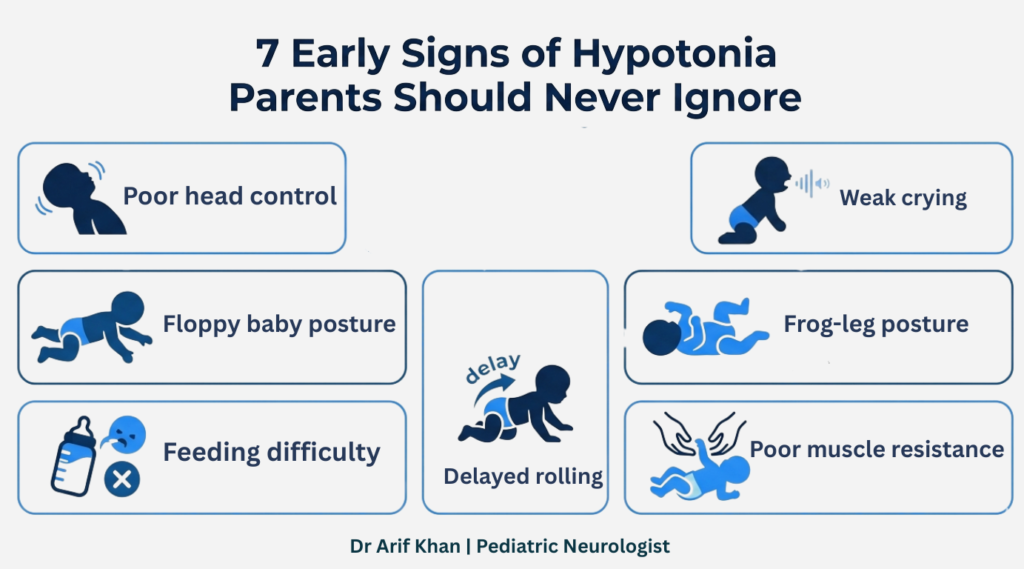
Common symptoms of hypotonia in babies include:
- Poor head control
- Floppy limbs when picked up
- Delayed rolling, sitting, or crawling
- Weak sucking or feeding difficulties
- Reduced reflexes
- Open mouth posture or drooling
The Frog-Leg Position: What Hypotonia Posture Looks Like in Newborns
Babies with hypotonia often lie in a “frog-leg” position, hips spread outward with little resistance, a postural indicator related to the broader spectrum of movement disorders in children.
How severe can it be? Understanding levels of Hypotonia
Not all cases are the same.
Hypotonia can range from mild to severe:
|
Severity level |
Features |
Functional impact |
|
Mild |
Slight delay in milestones |
May catch up with minimal therapy |
|
Moderate |
Noticeable motor delay |
Needs structured physiotherapy |
|
Severe |
Significant muscle control issues |
Requires long-term medical and supportive care |
How Is Hypotonia Diagnosed in Infants?
If hypotonia is suspected, your pediatrician may recommend a detailed assessment.
Diagnosis usually involves:
Clinical examination
- Muscle tone assessment
- Reflex testing
- Developmental milestone tracking
Imaging & tests
- MRI or CT scan (brain and spine)
- Genetic testing
- Blood tests for metabolic disorders
Developmental screening
Specialists evaluate motor skills, posture, and coordination.
Early diagnosis plays a crucial role in planning effective treatment.
Hypotonia vs Normal Developmental Delay: How to Tell the Difference
|
Feature |
Normal variation |
Hypotonia |
|
Muscle Tone |
Firm and responsive |
Floppy or loose |
|
Head Control |
Achieved by 3–4 months |
Delayed or absent |
|
Movement |
Active and controlled |
Limited or sluggish |
|
Reflexes |
Normal |
Reduced or weak |
Can Babies Outgrow Hypotonia? Prognosis and Long-Term Outlook
The outlook depends largely on the underlying cause.
- Mild hypotonia: Many children improve significantly with therapy
- Moderate cases: Progress steadily with consistent support
- Severe hypotonia: May require long-term care and adaptive support
Did you know?
Around 70–80% of children with mild hypotonia show significant improvement with early physiotherapy.
These numbers highlight one key message: Early action makes a real difference.
How Is Hypotonia Treated in Babies? Physiotherapy, OT, and Home Strategies
There is no one-size-fits-all treatment for hypotonia. The approach is tailored based on the cause and severity.
1. Physiotherapy (cornerstone of treatment)
-
Improves muscle strength and coordination
-
Encourages milestone achievement
-
Builds posture control
2. Occupational therapy
-
Enhances fine motor skills
-
Supports daily functional activities
3. Speech and feeding therapy
-
Helps babies with sucking, swallowing, and later speech challenges
4. Medical management
-
Treating underlying conditions (e.g., thyroid disorders, infections)
-
Medications if required
5. Sensory integration therapy
-
Helps children respond better to sensory inputs
6. Parent-guided home exercises
Dr. Arif Khan strongly emphasizes involving parents in therapy routines. Simple daily activities, like tummy time and guided play, can have a powerful impact.
What do studies say?
Early intervention can improve motor outcomes by up to 60% in developmental conditions.
Small daily steps that make a big difference
You can support your baby at home with:
- Tummy time (multiple short sessions daily)
- Gentle stretching exercises
- Encouraging reaching and grasping
- Providing supportive seating
Consistency matters more than intensity.
When Should You See a Pediatric Neurologist for Hypotonia? Warning Signs to Watch
Reach out to a specialist if you notice:
- Persistent poor head control after 3–4 months
- Feeding difficulties
- Lack of movement or interaction
- Delayed milestones compared to peers
Trust your instincts; parents often notice subtle changes first.
A gentle note on emotional well-being
Hearing that something might be “different” about your baby can be overwhelming. It’s okay to feel anxious. But remember, hypotonia is manageable, and many children go on to lead active, fulfilling lives.
With the right guidance, patience, and care, progress is not just possible, it’s expected.
Why choose Dr. Arif Khan for treating Hypotonia?
With over 20 years of experience, Dr. Arif Khan is the most renowned in the domain due to the following factors:
- Extensive experience in diagnosing and managing Hypotonia in babies, from mild delays to complex neurological cases
- Leads the Pediatric Neurology Department at Kids Neuro Clinic, ensuring specialized and focused care for neurological conditions in children
- Strong emphasis on early intervention, helping improve developmental outcomes during crucial growth stages
- Skilled in identifying underlying causes, including links between autism and hypotonia.
- Integrates multidisciplinary therapies, physiotherapy, occupational therapy, and feeding support for holistic care
- Uses evidence-based protocols aligned with global pediatric neurology standards
- Empowering families with practical home-based strategies
Cope up with Hypotonia with highly professional guidance at Dr. Arif Khan’s
Although it doesn’t always indicate the worst, your infant deserves attention if they have trouble controlling their head. Early assessment can offer assurance, clarity, and a clear course of action.
Dr. Arif Khan is a proponent of combining medical knowledge with tailored, compassionate care. Every child is different, and their growth path is no exception.
Book a timely consultation today.
Give your child the strongest start possible, because every milestone matters.
FAQs
- What is low muscle tone in babies?
Low muscle tone, also called hypotonia, means your baby’s muscles feel softer and less firm than usual. It can make movements like lifting the head or sitting up more difficult. - How to improve low muscle tone in babies?
Early therapies like physiotherapy, tummy time, and guided exercises can help strengthen muscles. A specialist like Dr. Arif Khan at Kids Neuro Clinic can create a tailored plan. - Is hypotonia the same as muscle weakness?
Not exactly. Hypotonia refers to reduced muscle tone, while strength may still be present. However, low tone can affect how muscles function over time. - What are the early symptoms of hypotonia in babies?
Common signs include poor head control, floppy limbs, delayed milestones, and feeding difficulties. - Can babies outgrow hypotonia?
Mild cases often improve significantly with early therapy. The outcome depends on the underlying cause. - When should I worry about my baby’s head control?
If your baby still struggles to hold their head steady after 3–4 months, it’s best to get an evaluation. - Is there a link between autism and hypotonia?
Yes, some children with autism may show low muscle tone early on, but not all babies with hypotonia develop autism. - What treatments are available for hypotonia?
Treatment may include physiotherapy, occupational therapy, feeding support, and managing any underlying condition. Early intervention makes a big difference.