
How do I Know if My Child Has Vision Problems
As a parent, you want your child to be healthy, confident, and able to thrive both in and out of school. Healthy eyesight plays a crucial role in learning, behaviour, and overall development, yet vision problems in children often go unnoticed.
Many children assume everyone sees the world the same way they do, which is why common vision problems in children can be missed, especially during the early school years. It is important to understand the symptoms and causes of vision problems in children. Seeing a specialist like Dr. Arif Khan, a child neurologist, can help find and treat vision issues early so your child gets the care and support they need.
Why Children’s Vision Is So Important
Almost 80% of what children learn in school is through their eyes. Whether they are reading, writing, drawing, or using screens, clear vision is important.
If eye problems go unnoticed, they can cause learning and behavior issues, headaches, and lower self-esteem. Finding these problems early is important because most can be treated if caught soon enough.
Common Vision Problems in Children
Parents should know about several common vision problems in children:
- Refractive errors: These include nearsightedness (myopia), farsightedness (hyperopia), and astigmatism, which cause blurry vision at various distances.
- Lazy eye (amblyopia): One eye does not develop proper vision, even with corrective lenses.
- Crossed or misaligned eyes (strabismus): Eyes may turn inward, outward, up, or down.
- Convergence insufficiency: Difficulty keeping both eyes working together while reading or focusing on close tasks.
- Eye infections or allergies: Redness, itching, or discharge that may affect vision temporarily or persistently.
Children may not always complain about these problems, so it is important to watch for signs and schedule regular eye exams.
How to Detect Vision Problems in Children
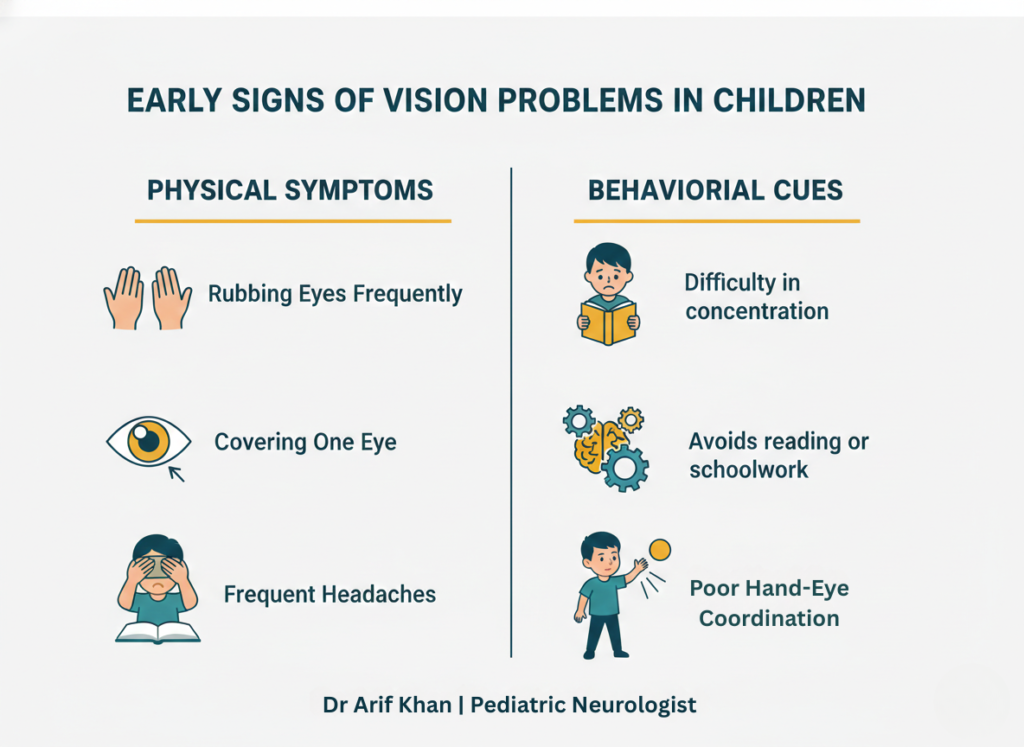
Many parents are unsure how to detect vision problems in children if their child does not complain. Look out for these warning signs:
- Squinting, rubbing eyes frequently, or excessive blinking.
- Sitting too close to the TV or holding books very close
- Complaints of headaches in children or eye strain
- Difficulty reading, skipping lines, or losing place while reading
- Poor attention span or avoiding close work
- Tilting the head or covering one eye
- Declining academic performance
In younger children, signs like slow visual development, not making eye contact, or eyes that remain crossed after infancy can point to a problem. Dr. Arif Khan usually does a full evaluation to find out if these issues are related to the eyes, the brain, or both.
School-Age Vision Concerns
School-age vision concerns in children are important because schoolwork becomes more demanding.
Kids spend more time reading, writing, and using screens, which can make hidden vision problems worse. Sometimes, vision issues are mistaken for learning or behavior and conduct issues.
Seeing a child neurologist like Dr. Arif Khan helps make sure these problems are found early and treated, leading to better results at school and with friends.
How to Treat Vision Problems
Once a vision problem is found, parents often want to know how to treat vision problems. The right treatment depends on the type of problem and may include:
- Prescription glasses or contact lenses to correct refractive errors
- Vision therapy to improve eye coordination, focusing, and tracking skills
- Eye patching or atropine drops for lazy eye
- Medical or surgical treatment for certain eye alignment issues or structural problems
Treating vision problems early helps your child see better and also supports healthy visual development, learning, and brain function.
Tips to Maintain Children's Healthy Vision
Good habits and prevention are important for eye health. Here are some practical tips to maintain a child’s healthy vision:
- Schedule regular eye exams, even if no symptoms are present.
- Encourage outdoor play, which has been linked to reduced myopia risk.
- Limit screen time and the 20-20-20 rule, taking a 20-second break every 20 minutes to focus on something 20 feet away.
- Ensure proper lighting while reading or studying.
- Make sure your child eats a balanced diet with plenty of fruits, vegetables, and foods rich in omega-3 fatty acids.
- Teach children not to rub their eyes and maintain good hygiene.
When Should Your Child Have an Eye Exam?
Children need eye exams when they are young and regularly as they grow. Routine vision checks can miss some problems, so a full exam by Dr. Arif Khan, a child neurologist, is important, especially if eye problems run in your family or your child has warning signs.
Why Choose Dr. Arif Khan
Finding and treating vision problems in children early can make a big difference in your child’s learning, confidence, and quality of life. If you are worried about your child’s eyesight or how they process what they see, do not wait. Dr. Arif Khan can give you answers, peace of mind, and help you take the next steps.
Dr. Arif Khan has experience in both neurology and vision development. He is committed to protecting and improving children’s vision at every stage, helping them do well in school, with friends, and in daily life.